 Telkom University
This was my final project for my Informatics degree at Telkom University, which I finished in early 2025. I made a customer service chatbot for the campus by fine-tuning Mistral 7B on questions people ask the helpdesk. Then I tested how good its answers were, with scores and by reading them myself. All of it ran on one GPU in Google Colab.
The idea
Students and people applying to Telkom University have a lot of questions about registration, fees, scholarships and campus services. Asking by phone, email or at the desk can mean a long wait. A chatbot built on a large language model could answer right away, in Indonesian.
Training a big model usually needs big hardware, though. QLoRA is a way around that. It shrinks the model to 4 bits and only trains a small add-on on top of it, so a 7 billion parameter model fits on one ordinary GPU. My thesis looked at how to fine-tune a campus chatbot this way, and how well it would do.
How I did it
- The data was 379 questions and answers from Telkom University’s student helpdesk FAQ and from questions sent to the campus customer service.
- I tried Falcon 7B first, but its Indonesian was bad. Mistral 7B did much better, so I went with that.
- Everything ran on a T4 GPU in Google Colab. Training used about 6 GB of its memory.
- I tested one setting at a time: epochs, learning rate, batch size, the LoRA settings, and regularization. The best value from each round carried over to the next. I ended up training close to 50 versions and uploaded them to Hugging Face.
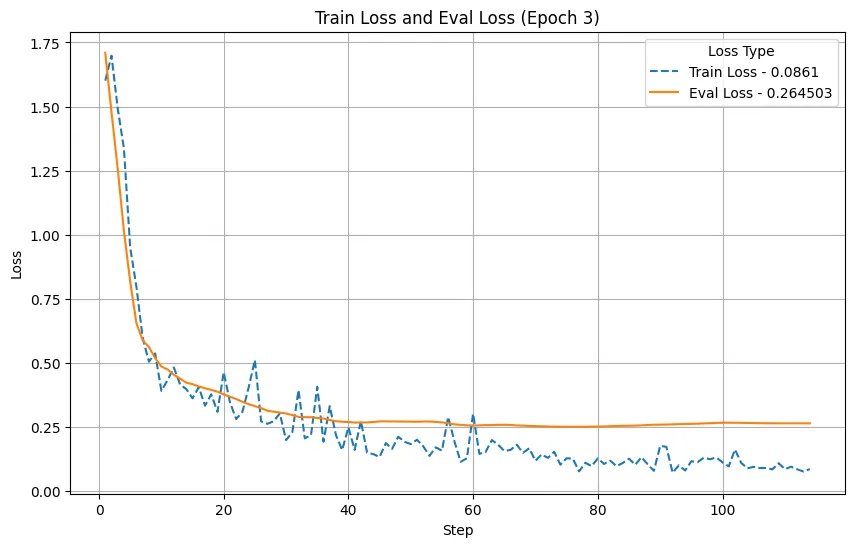 Training at 3 epochs, the setting I kept
More training wasn’t better. At 3 epochs the model did best on questions it hadn’t seen. Past that it started memorizing the training answers, and it got worse on new ones.
How well it did
I tested the final model on questions it never saw in training. On average it scored 0.70 on BLEU and 0.87 on ROUGE, which measure how close its answers are to the reference answers. I also read the answers myself to check if they fit the question.
That second check mattered. When I asked what to do about a forgotten password, the model gave a shorter answer than the reference and pointed to the contact page. BLEU gave it 0.004, but the answer still fit the question.
What I learned
Research like this is fun, but it costs a lot to run. I only had a MacBook with no CUDA, so everything ran on Colab. I kept running out of credits and paid for more out of my own pocket.
I tested every setting because I was curious, and I wanted to be sure about the results. Still, the best setup for this data won’t be the best for every case, so it has to be tuned again each time.